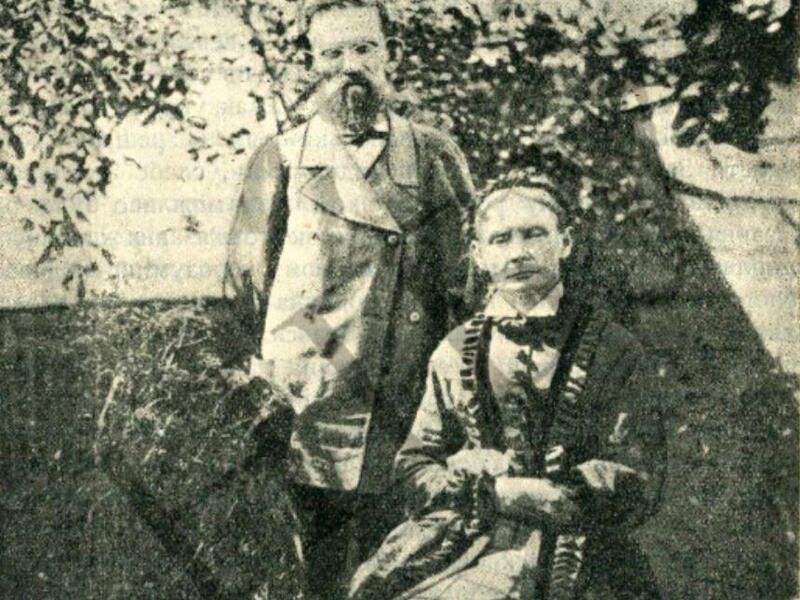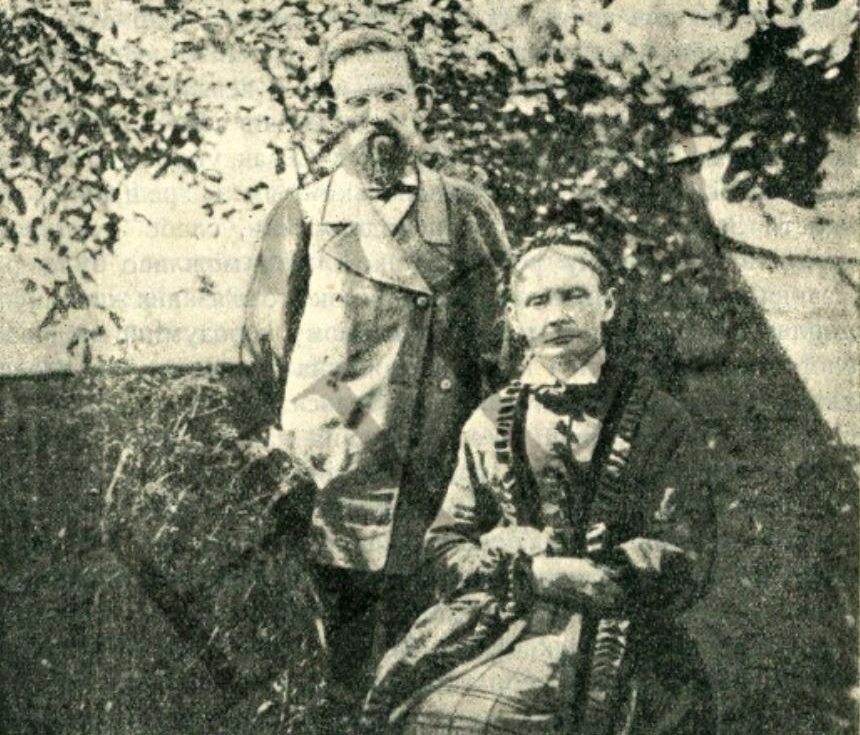
Serhii Ivanovych Vasylkivskyi and His Father
© Andrii Paramonov (Kharkiv)
An extensive bibliography is dedicated to the Ukrainian classical artist Serhii Vasylkivskyi. His biography has been detailed in thousands of publications, including notes, articles, and books produced by local historians, journalists, art critics, and scholars alike.
In these materials, Vasylkivskyi is presented as the son of a nobleman who relocated from Izium to Kharkiv in 1861 [1]. During the Soviet period, the artist’s father was mostly recorded as an official who “held a minor position in the county treasury” [2]. Another biography of the artist suggests that he was allegedly born in Kharkiv’s Moskalivka neighborhood. In this same source, his father is listed as an official of the “Department of State Revenues” [3]. In more recent research, one can find information about the artist’s grandfather, who is alternately described as either a Cossack officer or a chumak (a traditional Ukrainian salt trader). The latter version is supported by Wikipedia and the Ukrainian Institute of National Remembrance, though, unfortunately, neither provides references to a primary source. Modern authors sometimes "record" Serhii Vasylkivskyi's father as a scribe or a clerk at the Izium hospital, while his wife is described as a noblewoman, albeit from an unspecified noble family. In short, there are numerous versions, yet not a single archival source to back them up.
The first known representative of the Vasylkivsky noble family in the Sloboda Ukraine Governorate was the priest Mykola Andriiovych Vasylkivskyi who officially proved his noble descent in 1807. His surname was inscribed into the second volume of the genealogical book of hereditary nobility [4]. It is worth noting that other priests bearing the surname Vasylkivsky had, in fact, been recorded among the nobility even earlier, but, unfortunately, we cannot definitively link them to this specific family. One of Mykola Vasylkivskyi’s sons was Fedir, the grandfather of the artist Serhii Vasylkivskyi. Whether Fedir was a Cossack or a chumak remains unknown. However, we do know that he studied at the Kharkiv Collegium, upon completion of which he was ordained as a priest.
In the early 1810s, a new priest, Fedir Mykolaiovych Vasylkivsky, began his ministry at the Church of the Nativity of the Theotokos in the sloboda of Tsareborysiv, Izium County (now the village of Oskil in the Izium District of the Kharkiv Oblast). On September 19, 1816, his wife, Hanna Kyrylivna, gave birth to their daughter, Taisiia [5]. In 1823, the couple welcomed a son, Ivan, the future father of the artist.
Ivan Fedorovych Vasylkivskyi’s service record from 1857 provides detailed information regarding his career [6]. As the son of a priest, he studied at the Kharkiv Theological Seminary, but he did not complete even the lower division and had been dismissed. The reason for this can be found out later. Most likely, Ivan’s education was sponsored by his father, and the latter lost the financial ability to support his offspring at the seminary. Alternatively, in the opinion of the seminary instructors, the student simply lacked a calling for spiritual ministry.
After leaving the Seminary, Ivan Vasylkivskyi entered the civil service. While searching for employment, he found himself in the county town of Starobilsk, where on April 11, 1845, he was appointed as a second-class clerk in the county treasury. At the first opportunity, in the spring of 1846, he transferred to the Izium city police, also as a clerk. That same year, he managed to move to the Izium County Department of State Property, where he served as the acting secretary and accountant for the Izium County Hospital. However, he was not formally confirmed in these positions until 1850.
In 1849, Ivan Vasylkivskyi was promoted to the rank of Collegial Registrar, and in 1853 to that of Provincial Secretary. Around the same time, he married. His wife was named Paraskeva Huriivna, though her social background remains unknown to this day. It was to this couple in Izium that the future artist, Serhii Vasylkivskyi, was born on October 6, 1854. Interestingly, official biographies list his birth date as October 7, which was likely the date of his baptism.
The Vasylkivsky family was short of money, that is exactly why Ivan Vasylkivskyi transferred to the Okhtyrka city police on May 27, 1855, taking the position of private pristav. His annual salary at this post amounted to 57 rubles and 14½ kopiykas in silver. While serving in this position, he was promoted in 1857 to the rank of Collegiate Secretary, and in 1863, as Okhtyrka’s private pristav, Vasylkivskyi received his final rank, Titular Counselor. Following the implementation of the police reform, he moved to Kharkiv, as the reform abolished the institution of private pristavs within the municipal police. Vasylkivskyi most likely changed his place of residence in 1864.
There was no need for Ivan Fedorovych Vasylkivskyi to formally verify his hereditary nobility, as he presumably relied on his father’s supporting papers.
In Kharkiv, the Vasylkivsky purchased a vacant plot on Katerynynska Street near the Yedinoverie Cemetery. It was in 1865 that the Moskalivka suburb was officially incorporated into the city limits. The house numbering for the Vasylkivsky property changed several times. Initially, it was No. 35, then No. 41, later No. 57, and by 1901, it was designated as No. 71. The choice of this specific location was evidently driven by its low cost. Almost immediately, the owners built a wooden house there, which appears for the first time in the 1874 List of Homeowners. After the regulation of Kartashevskyi Lane, the Vasylkivsky house received a double address, facing both Katerynynska Street and Kartashevskyi Lane simultaneously. On the latter, it was always listed as No. 1. During the 1870s, the house was faced with brick, possibly only partially, as the family was not affluent.
The artist frequently depicted his parental estate, although none of his paintings ever included the street-facing façade of the house. One of these pieces, titled My Backyard, was often exhibited in Kharkiv, much to the delight of the local public.
In another painting by the artist, titled The Family House, we see the side façade of the Vasylkivsky residence.
Serhii Vasylkivskyi’s father passed away in either 1880 or 1881, after which the urban homestead passed to his wife, Paraskeva Huriivna. She died on January 28, 1904. Her funeral service was held at the Transfiguration Church in Kharkiv, and she was buried the following day at the city's Ioanno-Usiknovenske Cemetery [7].
Today, the site of the former Vasylkivsky estate at the corner of Katerynynska Street and Kartashevskyi Lane stands empty. All that remains of the house is a small section of the facade, incorporated into a fence. This sacred site of Ukrainian painting is unlikely to be marked as a landmark on Kharkiv maps, even though, in civilized countries, even such a minor remnant of a building would be properly valued and protected by the state.
LIST OF REFERENCES:
1. Biograficheskiy slovar byvshikh pitomtsev Pervoy Kharkovskoy gimnazii za istekshie stoletie s 1805 po 1905 god [Biographical Dictionary of Former Students of the First Kharkiv Gymnasium over the Past Century from 1805 to 1905]. Kharkiv, 1905, p. 50.
2. Nikolaiev, O. Serhii Vasylkivskyi. Zhyttia i tvorchist [Serhii Vasylkivskyi. Life and Work]. Kharkiv, 1927, p. 7.
3. Rutkovskyi, M. Serhii Vasylkivskyi 1854–1917. Praha: Vydavnytstvo Ukrainskoi molodi [Prague: Ukrainian Youth Publishing House], 1927, p. 6.
4. State Archives of Kharkiv Oblast (SAKO). Fund (F.) 14, Inventory (Op.) 11, Archival Unit (Od. zb.) 1.
5. SAKO. Fund (F.) 40, Inventory (Op.) 110, Archival Unit (Od. zb.) 284, Sheet (Ark.) 434 back (zv.).
6. SAKO. Fund (F.) 4, Inventory (Op.) 9, Archival Unit (Od. zb.) 168, Sheets (Ark.) 1294–1311.
7. SAKO. Fund (F.) 40, Inventory (Op.) 121, Archival Unit (Od. zb.) 198, Sheets (Ark.) 137 back (zv.)–138.